
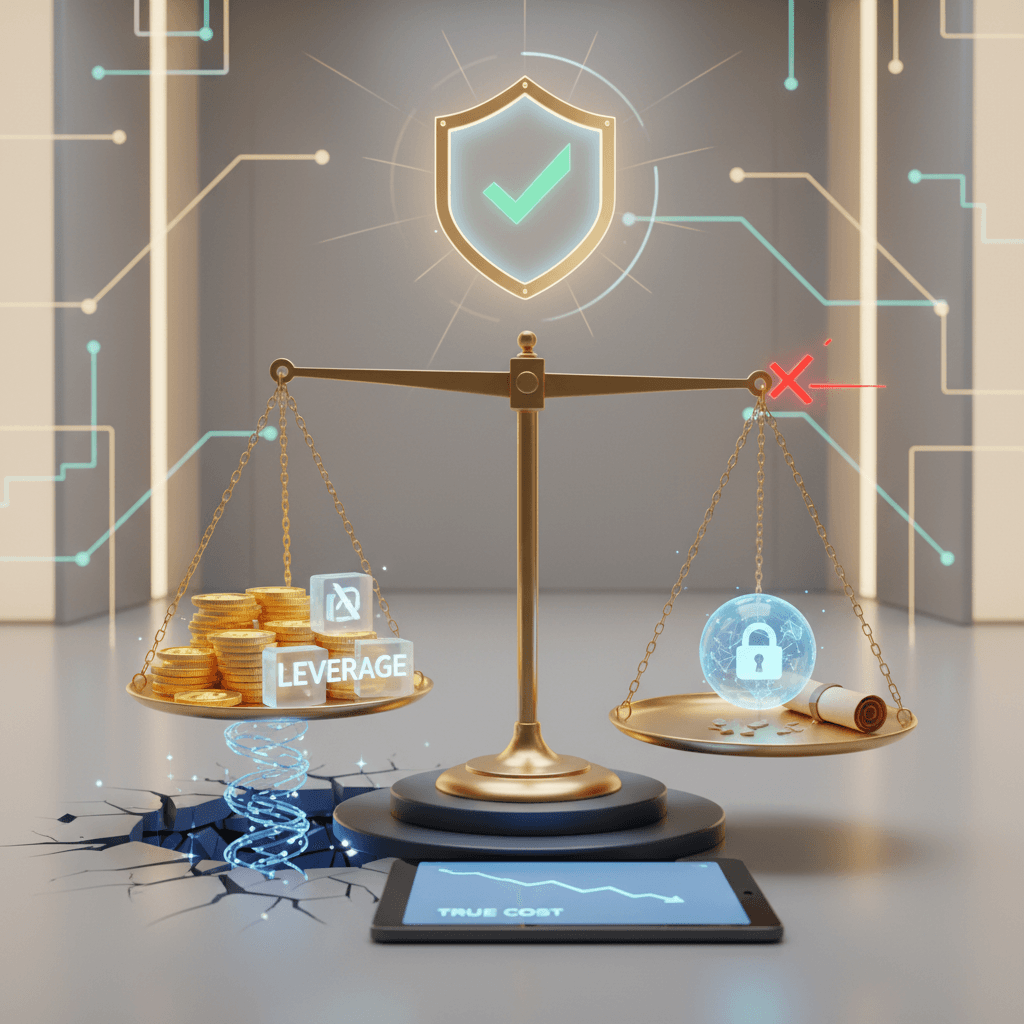
Leverage and margin trading are everywhere in the crypto world. Exchanges highlight the potential for huge gains, but rarely spell out how quickly things can go wrong.
For most everyday traders, the biggest danger lies in overleveraging: taking on more risk than your account (or nerves) can handle. By the time you realize the true cost, your funds may already be gone.
This article breaks down what overleveraging looks like in real crypto futures and margin trading, what happens during liquidation events, and step-by-step ways to reduce risk and keep your capital safer.
What Does Overleveraging Really Mean in Crypto?
In the simplest terms, overleveraging is borrowing more money (through leverage or margin) than you can realistically afford to lose. Crypto exchanges often let you trade with 5x, 10x—even 100x—leverage on certain products. This means that with every $1 of your own money, you could control $100 worth of a coin or token.
While the potential profit looks tempting, the downside is steep: even a 1% move against your position with 100x leverage can wipe out your entire account. Overleveraging isn’t just about big numbers on the trading dashboard. It’s about committing more risk than your plan, bankroll, or temperament can logically handle.
Most dangerous of all, overleveraging isn’t obvious at first. With crypto’s fast paced markets and volatile moves, it’s easy to fall into the trap of chasing losses or believing one more trade will recover it all. This mentality often leads to much deeper losses and emotional decision-making.
- Overleveraging = risking more than you can afford using borrowed funds
- High leverage = amplified gains and losses
- Crypto volatility makes overleveraging even riskier than in traditional markets
- Small price swings can cause big liquidations
How Leverage Multiplies Risk and Losses
Leverage uses borrowed capital to expand your trading position, but it’s a double-edged sword. The core principle is that gains are multiplied—but so are losses, by the exact same factor.
Imagine you enter a long trade with 10x leverage using $100 of your own money. Now, you’re trading as if you have $1,000. If the asset price increases by 10%, you double your money and walk away with $200 equity. But if the asset drops by just 10%, your entire initial capital is gone. The danger compounds quickly if you add more trades or increase position size after losses.
Crypto’s 24/7 markets and frequent double-digit moves mean it’s not just possible, but likely that even a small miscalculation leads to a rapid loss of the entire leveraged position. Many traders underestimate how quickly a bad swing can deplete all available margin—even before they can react.
- 10x leverage = 10% move against you wipes out 100% of your funds
- Crypto assets can swing 5-20% or more in a single day
- Losses are automatic, not optional, if liquidation levels are hit
Liquidation: The Real Consequence of Too Much Leverage
Liquidation is when the exchange automatically closes your position because your losses have eaten through your margin or collateral. It’s designed to protect the exchange—not you—from further losses.
Many traders, especially newer ones, mistakenly believe that if a position moves against them, they’ll have a chance to close it manually. But in high-leverage products, prices can move so fast that your position is closed at the first margin breach—often at a worse price than you’d choose.
Also, liquidation can carry fees or extra slippage, depending on the platform, squeezing more out of your remaining capital. In some cases, a flash crash or low liquidity market can cause losses greater than your initial account balance (though most big platforms try to limit this risk).
- Liquidation = forced closure of your trade by the exchange
- Can erase your initial margin and sometimes more
- Happens quickly, sometimes before you can act
- Usually involves extra fees or costs
Psychological Traps: Why Traders Overleverage and Ignore the Risks
The reasons behind overleveraging are often psychological, rather than purely rational. Many traders start with small positions, but after some wins—or worse, after a string of losses—they increase leverage to chase profits or try to make back what they’ve lost.
The fast pace of crypto, plus the constant stream of big-profit stories on social media and forums, fuels a cycle of FOMO (fear of missing out). This encourages people to take bigger risks than they’d take elsewhere, often without truly understanding the math or mechanics behind leverage.
Recency bias, overconfidence, and a misunderstanding of how quickly margin can disappear create the perfect storm for overleveraging. Once caught in this cycle, it becomes much harder to make clear-headed decisions. In short: emotion, not logic, tends to drive the biggest leveraged losses.
- FOMO and 'get rich quick' stories fuel risky trades
- Loss chasing often leads to bigger position sizes
- Emotion easily clouds logic in fast-moving markets
Knowing Your Real Liquidation Price: Why Numbers Matter
One danger for new traders is not understanding the precise point at which their position will be liquidated. Exchanges often label liquidation prices in small text, or behind a few clicks, so it’s easy to overlook.
The liquidation price is not a negotiating point—it’s the hard barrier at which you lose your position. Leverage amplifies not just your potential gain, but how close your liquidation price sits to your entry. The higher the leverage, the tighter this gap, and the more easily sudden price swings can force closure.
Before placing any leveraged trade, it’s crucial to know your exact liquidation price, including the impact of trading fees and price slippage. Don’t leave it to chance or guesswork. Write it down, double-check, and be honest about how close it is to recent volatility or support and resistance levels.
- Liquidation price is where your losses wipe out your collateral
- Higher leverage brings liquidation closer to your entry
- Know this number before you enter a trade
Five Practical Steps to Avoid Overleveraging in Crypto
The lure of quick profits is real, but so are the risks. Here are steps you can build into your trading routine to avoid common leverage pitfalls:
1. Always Use Less Leverage Than Allowed: Exchanges offer high leverage to attract volume, but this doesn’t mean you should take the maximum. Stick with a level you understand and can stomach—even 2x or 3x multiplies risk fast in volatile assets.
2. Size Positions Based on Risk, Not Greed: Work backward from what you can afford to lose, not just from your account size. A small, manageable position is far safer than a big, emotional bet.
3. Implement Concrete Stop-Losses: Don’t leave your downside up to chance. Use platform tools to set stop-loss orders well before the liquidation price, so you control the exit—not the exchange’s system auto-liquidating you at the worst possible moment. Make sure you understand how stop-losses work on your trading platform—including any possible slippage in fast markets—before you rely on them to protect your funds (for more, see our article on crypto stop-loss strategies).
- Limit leverage to safer, reasonable levels—even below what’s available
- Position sizing based on risk tolerance, not account max
- Stop-loss orders as a basic protective tool—set them before trading
- Plan exits before entering trades
- Practice trades with demo accounts if unsure
Monitoring and Responding to Margin Calls: Staying Ahead of Trouble
A margin call is your warning signal that funds are running low to support your position. In crypto, margin calls can happen quickly, and with volatile markets, the window to act is often very short.
If you receive a margin call, your first priority is to act—either by adding collateral, reducing your position, or closing the trade. Too often, traders wait, hoping for a price rebound, but this almost always leads to forced liquidation and larger losses.
Monitor open positions and margin ratios regularly (set alerts if your exchange provides them). Don’t rely on emails or notifications alone; always keep an eye on your account balance and active trades, especially during high volatility.
- Margin calls mean your trade is at risk of liquidation
- Don’t hesitate—reduce risk or close trades quickly
- Regular monitoring can help you spot trouble before it’s too late
Checklist: Spotting and Avoiding Overleveraged Trading Habits
Use this straightforward checklist as a regular self-audit before, during, and after placing any leveraged trade:
Before a trade: Do you know the exact liquidation price? Is your risk less than 2-5% of your total portfolio on this one position? Are you using less leverage than the maximum allowed? After you enter: Is your stop-loss set? Are you actively monitoring your position for margin risk? Do you know your exit plan?
If you answer ‘no’ to any of these, reconsider the size and strategy of your trade before putting more funds at risk.
- Check liquidation price before placing trades
- Limit each position’s risk relative to total portfolio
- Set a stop-loss and exit plan every time
- Avoid increasing leverage to recover losses
- Review previous trades for emotional decision-making patterns
Frequently asked questions
Can you lose more money than you deposit when trading leveraged crypto?
In most major crypto exchanges, your maximum loss is usually limited to your deposit (the margin you provide). However, there are rare cases in extreme volatility or low-liquidity markets where slippage and fees can result in losses exceeding your collateral. It is vital to know how your specific platform handles liquidation and negative balances.
Should beginners use leverage or margin in crypto trading?
Leverage and margin products are considered high risk and generally not recommended for beginners. They amplify both gains and losses, which means even a small market move the wrong way could result in the loss of your trading capital. If you’re new, consider starting with spot trading and use demo accounts to learn the basics of risk management first.
How often should I check my margin or leveraged positions?
With crypto’s round-the-clock trading and fast price swings, it’s essential to monitor leveraged positions actively. Set alerts, check at least several times per day, and especially during market news events. Do not leave leveraged trades unattended overnight without clear risk controls in place.
Conclusion
Overleveraging in crypto futures and margin trading is a common but deeply dangerous practice. The fast pace of the markets, combined with high leverage options and the psychological urge to win back losses, makes it all too easy to fall into a cycle of escalating risk.
By understanding how leverage multiplies not just profits but also losses, and by using strict position sizing, stop-losses, and careful monitoring of margin, traders can greatly reduce the chances of catastrophic liquidation events.
Treat risk management as your first priority—not an afterthought. Use the checklists and practical safety steps in this article to build better trading habits over time, so any wins you achieve are not erased by a single overleveraged mistake.
Related reading
- How Leverage Tokens and Derivative ETFs Expose Crypto Traders to Hidden Risks
- Crypto Leverage and Futures Trading: Common Mistakes and How to Avoid Them
Disclaimer: This content is for educational purposes only and should not be considered financial or investment advice. Always do your own research before making financial decisions.